
Georgia: The Country That Surprises Everyone Who Goes
A word that means agriculture. A culture built entirely around what grows from the earth.

There is a detail about Georgia that stays with you long after you have left. The word Georgia, or Sakartvelo as Georgians call their own country, derives from a root that means agriculture. Not a king, not a god, not a geographical feature. Agriculture. The harvest. The earth and what comes from it. That single etymological fact explains almost everything about what Georgia is and why it feels so different from anywhere else you have been. The wine, the food, the music, the extraordinary tradition of the feast, the relationship between the people and the land they have been working for four thousand years: all of it flows from that same source. Georgia is a country that has organised its entire civilisation around the act of growing things and the extraordinary pleasure of sharing what grows.
It is also one of the most surprising destinations in the world for the traveller who arrives expecting something familiar. Georgia spent seven decades under Soviet rule and the traces of that era are everywhere, in the brutalist architecture that frames ancient Orthodox churches, in the collective infrastructure that the country is still in the process of repurposing, in the particular quality of a society that is simultaneously ancient and post-Soviet and neither of those things completely. The language, one of the oldest and most visually distinctive writing systems in the world, bears a remarkable resemblance to the Basque script of the Pyrenees despite having developed entirely independently, on the other side of a continent, from a completely unrelated civilisation. Georgia is full of these moments of the unexpected, of details that do not fit the patterns you bring with you and that force you to pay a different kind of attention.
Tbilisi: a city of beautiful contradictions
Tbilisi announces itself gradually. You arrive into a city of carved wooden balconies overhanging narrow lanes, Soviet apartment blocks framing views of a medieval fortress on the cliff above, sulphur bath domes rising from the Abanotubani district where the thermal springs have been bringing people to bathe since the city was founded in the fifth century. Persian mosques sit beside Orthodox churches that sit beside synagogues that sit beside Catholic basilicas, each built within a few streets of the others, a physical record of every civilisation that has ever passed through or occupied this city and left something behind before moving on.
The old town rewards those who move slowly through it without a fixed agenda. The lanes that run off the main streets reveal unexpected courtyards, iron staircases leading to wooden balconies, workshops where craftsmen are making things by hand using techniques that have not changed in generations. The Narikala fortress on the hill above the city offers the finest view of Tbilisi and the Mtkvari River below, and the walk up through the old town to reach it is as good as anything the city offers at ground level.
The clock tower of Rezo Gabriadze, the beloved Georgian artist and puppeteer, stands in the old town and performs at noon and at seven in the evening, when a small angel emerges from a door near the top and strikes the bell. It is a small, entirely handmade thing of extraordinary character and it has become one of the most loved objects in a city that contains many remarkable things. The puppet theatre beside it, also Gabriadze's creation, is one of the finest small theatres in Europe. An evening there, watching one of his productions in a space that seats perhaps a hundred people, is one of the most quietly extraordinary cultural experiences Tbilisi offers.
The natural wine bars of Vera and the restaurant streets of the old town have made Tbilisi one of the most talked-about food and drink destinations in Europe over the past decade. The khinkali, the twisted dumplings filled with spiced meat and broth that must be eaten by hand and drunk before biting, are everywhere and are the right thing to order in almost any setting. The khachapuri, the boat-shaped bread filled with cheese and egg that is Georgia's most iconic dish and one of the finest things you will eat anywhere in the Caucasus, appears on every menu and varies significantly in quality. Finding the right version, in the right place, with someone who knows the difference, matters more than it might seem.
The honest truth about Georgian food is that it is extraordinary but not endlessly varied. The same dishes, executed with different degrees of care and different qualities of ingredient, appear on almost every table in almost every region. This is not a criticism. It reflects a food culture that is deeply rooted in specific traditions rather than constantly reinventing itself, and the pleasure of eating in Georgia comes from understanding those traditions deeply rather than from novelty. The wine, by contrast, is endlessly varied and endlessly surprising.

The supra: the feast that explains everything
To understand Georgia you must sit at a Georgian table. Not a restaurant table, though those can be extraordinary, but a table in someone's home or in a farmhouse in Kakheti or in a courtyard in the old town of Tbilisi where a supra has been laid for guests. The supra is Georgia's most important cultural institution and the experience through which the country reveals itself most completely.
A traditional Georgian feast is not dinner. It is a ritual that can last four or five hours, governed by a tamada, the toastmaster elected by the table, who leads the gathering through a minimum of sixteen ceremonial toasts. Each toast covers a specific subject: God, the country, the dead, the living, love, peace, guests, children, the vine and the harvest. They are not perfunctory. Each one is a small speech, often eloquent and sometimes genuinely moving, and between them the food arrives in waves and the wine flows from the qvevri and the conversation deepens in the way that only long meals can produce.
The singing begins when the mood is right. Georgian polyphonic singing, three independent vocal lines combining into harmonies that exist nowhere else in the European musical tradition, is a UNESCO Intangible Cultural Heritage of Humanity and it sounds completely unlike anything you have heard before. It does not announce itself. It simply begins, usually from somewhere around the table, and builds into something that fills whatever space it is performed in. Hearing it for the first time in a private setting, at a table rather than in a concert hall, is one of the most unexpectedly moving experiences Georgia offers.

Kakheti: the oldest wine in the world
An hour and a half east of Tbilisi, the Alazani Valley opens into a landscape of vineyards, Orthodox monasteries and the particular quality of golden afternoon light that makes the Kakheti wine country one of the most beautiful agricultural landscapes in Europe. This is where wine was born. Archaeological evidence places the earliest winemaking in Georgia at around 6000 BCE, making the tradition here eight thousand years old and the oldest in the world by a significant margin.
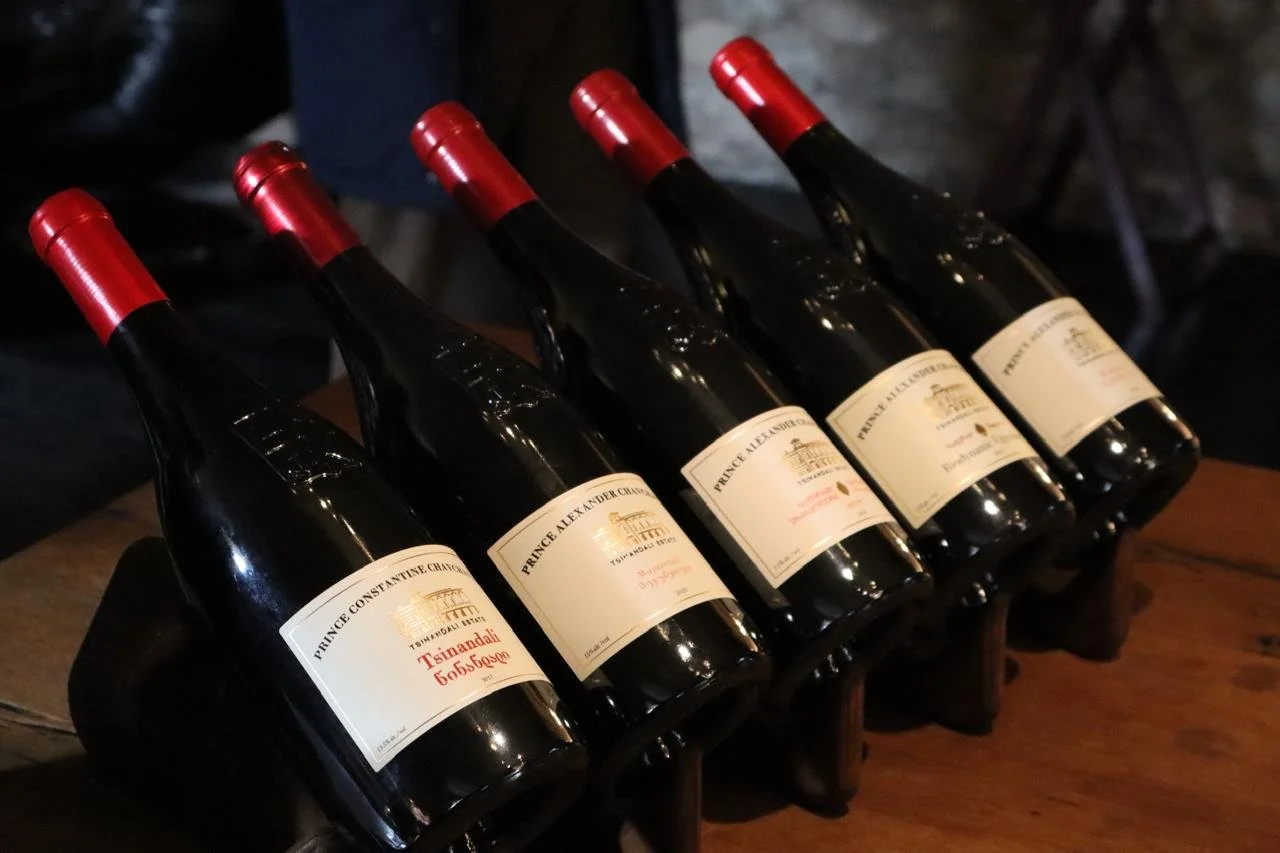
The wine is made differently from anywhere else. The qvevri method, fermenting and ageing in large clay vessels buried in the earth, produces wines of a character that is genuinely unlike anything made by conventional European winemaking. The amber wines, made from white grapes fermented on their skins in the ancient manner, have a depth and a texture that surprises almost everyone who encounters them for the first time. The Rkatsiteli and Mtsvane varieties used for the whites and the Saperavi used for the reds are indigenous to Georgia and exist nowhere else in the world.
A private visit to a small family winery in the Alazani Valley, tasting with the winemaker in the cellar where the qvevri are buried, understanding the specific philosophy behind a method of production that has been passed down within families for generations without interruption, is one of the most genuinely educational and most pleasurable wine experiences available anywhere in Europe. In September and October, during the harvest, participating in the rtveli, the Georgian grape harvest, treading fruit in the traditional manner and understanding the physical connection between the vine and the vessel, makes the eight-thousand-year tradition entirely tangible.
The great monastery of Alaverdi in the heart of Kakheti, which has been producing wine for the Georgian Orthodox church for fifteen centuries, is one of the most significant and most atmospheric religious sites in the country. The combination of the monastery, the wine cellars beneath it and the landscape of the Alazani Valley surrounding it makes for one of the finest afternoons available anywhere in the Caucasus.
Kazbegi and the helicopter
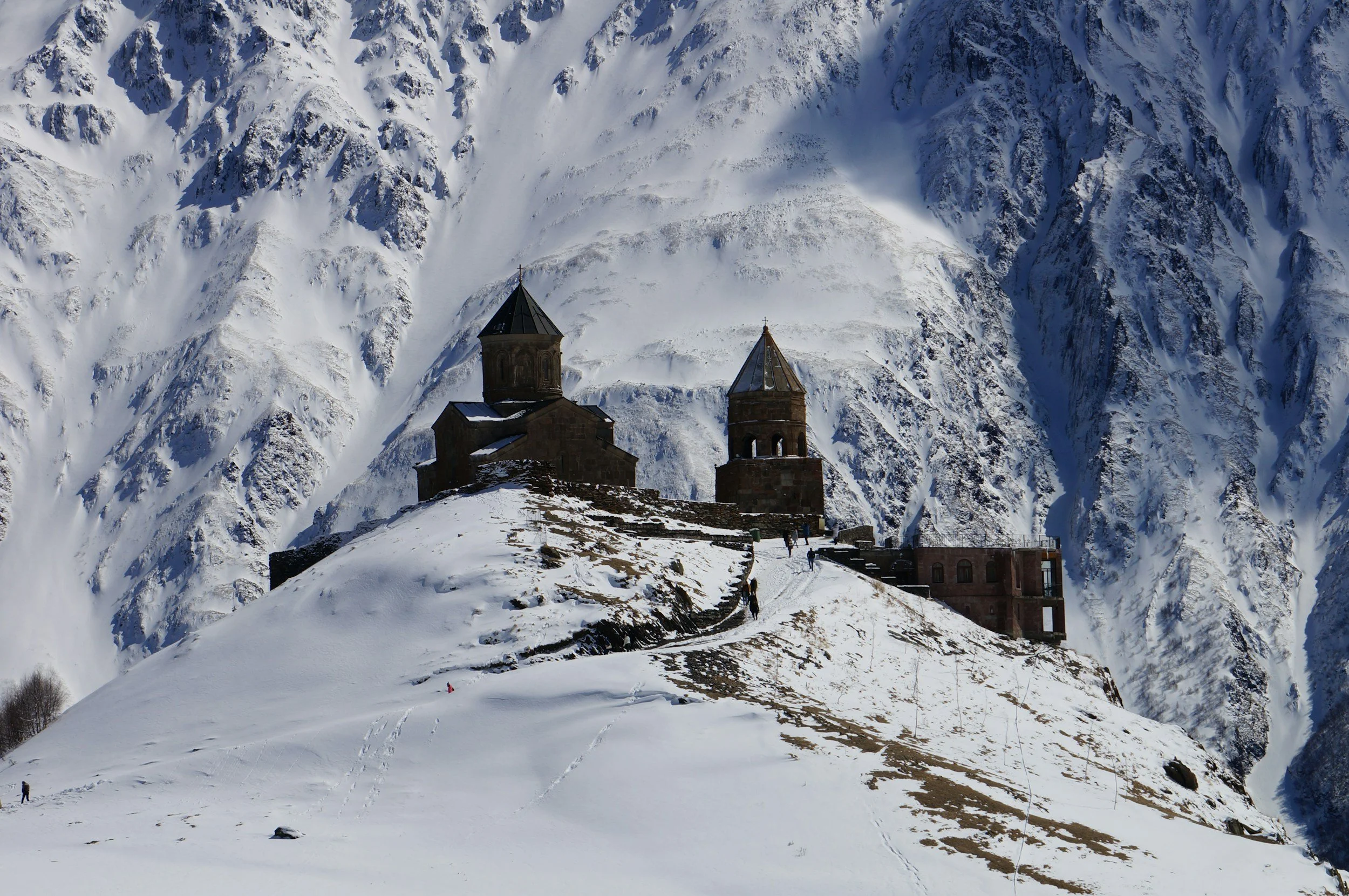
The drive north from Tbilisi along the Georgian Military Highway is one of the most dramatic in Europe. The road rises through gorges of increasing scale, past Soviet-era infrastructure that is gradually being reclaimed by the mountain landscape, to the high plateau of Kazbegi where the fourteenth-century Gergeti Trinity Church sits on a promontory at 2,170 metres with the five-thousand-metre peak of Mount Kazbek rising behind it. On a clear day, and clear days are not guaranteed in the Caucasus, the view from the church across the surrounding peaks is one of the finest mountain views available in Europe.
The helicopter is the right way to experience this landscape if you are combining Kazbegi with a visit to the Kakheti wine country. Flying over the Caucasus range between the city and the wine valley reveals the scale of the mountains in a way that the road, dramatic as it is, cannot convey. The peaks, the glaciers, the deep gorges and the extraordinary transition from high alpine landscape to the warm agricultural valley of the vine country, seen from above in the space of an hour, is one of the most memorable things Georgia offers.
Gori and Uplistsikhe: the ancient plains
Most visitors to Georgia combine Tbilisi with Kakheti and Kazbegi and consider the country seen. Those who go further, into the central plains around Gori and the ancient cave city of Uplistsikhe, find something that the more travelled route cannot offer.
Gori sits on the plains of central Georgia, the birthplace of Joseph Stalin and home to the museum that the Soviet Union built in his honour and that remains, in its extraordinary unreconstructed form, one of the most fascinating and most uncomfortable places in Georgia. The building itself, a Stalinist monument to a Stalinist dictator, and the exhibits inside it, which treat the subject with a reverence that the outside world abandoned decades ago, are a study in the complexity of historical memory in a country that is still in the process of deciding how to understand its own twentieth century.
Uplistsikhe, the ancient rock-hewn city carved into a sandstone cliff above the Mtkvari River a short drive from Gori, is one of the most extraordinary and most undervisited archaeological sites in the Caucasus. Occupied continuously from the early Iron Age through to the medieval period, it contains carved halls, wine cellars, a theatre and a basilica church all cut directly from the living rock by hand. It is a more significant and more rewarding site than the more visited Mtskheta, which is worth a brief stop on the road rather than a dedicated visit, and it deserves at least half a day with a specialist guide who can explain the three thousand years of continuous habitation visible in the layers of the cliff face above the river.

Why Georgia now
Georgia is at an interesting moment. The country has been investing seriously in tourism infrastructure over the past decade and international visitor numbers have been growing steadily, but it remains significantly less visited than comparable European destinations and the private luxury travel space specifically is almost entirely uncrowded. The combination of extraordinary wine, a food culture of genuine depth, one of the most dramatic mountain landscapes in Europe, a capital city of remarkable character and a hospitality tradition that treats guests with a warmth that feels entirely genuine rather than performed makes Georgia one of the finest value propositions in luxury travel right now.
The traveller who goes to Georgia in the next few years, before the discovery curve catches up with the reality of what the country offers, will find something that most of the world has not yet found. That is a rarer and rarer thing in European travel and it is worth the journey specifically because it is.

Ready to start planning your Georgia journey? Explore our Georgia destination page for more on regions, experiences and the best time to visit. When you are ready, get in touch and we will begin designing your journey around you.